Red Legs Kicking
Aldo Leopold and the Art of the Hunt

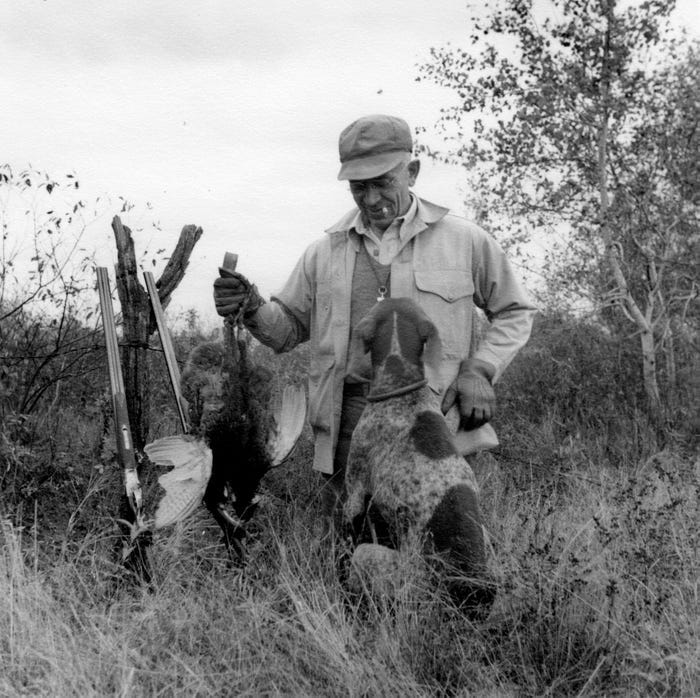
Within the familiar pages of A Sand County Almanac lies a brief yet extraordinary passage often bypassed by readers drawn to Aldo Leopold’s more celebrated essays—the magisterial Land Ethic or the haunting Thinking Like a Mountain. Tucked quietly between these moral summits rests “Red Legs Kicking,” a short vignette that might easily be mistaken for a mere hunting anecdote. For years, I too passed over it, turning instinctively to the weightier treatises that seemed to define Leopold’s legacy. But upon rereading it decades later, I found that this slender meditation holds the seed of the entire Leopoldian philosophy: that attention—pure, disciplined, ethical attention—is the foundation of all right relationship with the land.
In “Red Legs Kicking,” Leopold recalls an early lesson from his father, who believed that a true sportsman never fired at a bird sitting still. Fair play demanded that one meet the quarry in motion, in flight, and on its own terms. To strike a bird on the ground was, in his father’s words, a “sin”—a breach of both discipline and decency. That lesson, for Leopold, became something more than a sporting rule. It was a code of conduct that extended into every sphere of life: an ethic of engagement, humility, and attentiveness.
The hunt, in this light, becomes a way of seeing. The hunter is not merely a taker of life but a student of motion, a practitioner of patience. He learns to move with the rhythm of the world, to discern the subtleties of sound, wind, and light. In that act of disciplined observation lies the root of Leopold’s entire ecological philosophy: the conviction that ethics begins not in principle but in perception. Before one can think like a mountain, one must first learn to see like a hunter.
To meet the world in flight—to engage the living world as participant rather than conqueror—is a moral posture we have largely forgotten. Today, we live in an age of instant capture. We take photos instead of pauses, extract resources without reflection, and accumulate information without wisdom. We “shoot” with cameras, consume with eyes, and scroll endlessly through a still life of our own making. We no longer meet life in motion; we frame it, freeze it, and filter it.
Leopold’s little essay, therefore, reads like a mirror held up to the moral blindness of our own time. The “red legs kicking” of the bird he recalls—those vivid last tremors of life—are not a celebration of conquest but a moment of ethical awakening. They remind us that every act of taking carries weight. The trembling of the bird is the trembling of conscience. To see it, to feel it, to not turn away—this is the actual hunt.
Yet the art of the hunt is not confined to the field or the season. Hunting, as Leopold practiced it, is a mindset—an orientation toward the world characterized by respect, restraint, and receptivity. It is an antidote to the distracted consumerism that defines modern life. When we hunt rightly, we do not seize what stands still; we engage what moves. We attune ourselves to the living pulse of things.
The same attentiveness required of a hunter can guide how we read, listen, and live. It can govern how we approach our work, our relationships, our citizenship, even our grief. To live by the hunter’s ethic is to resist the impulse toward easy capture—to approach life as something to be met, not managed. Leopold’s father’s dictum—“only shoot a bird in flight”—becomes, in this sense, an injunction against passivity. It calls us to meet life as it is moving, wild and unpredictable, never entirely within our control.
This ethic of encounter, of fair engagement, forms the moral foundation for Leopold’s later Land Ethic. In Thinking Like a Mountain, he recounts another formative experience: as a young forester, he joined in the killing of a pack of wolves, believing it would improve the deer population. But when he reached the dying wolf and saw the “fierce green fire dying in her eyes,” he experienced a moment of irreversible insight. He realized that the wolf, and even the mountain itself, possessed a knowing—a wisdom that had been excluded from human calculation. “There was something known only to her and to the mountain,” he wrote, and that realization shattered his faith in the mechanistic view of Nature as a resource to be managed.
That moment, like the father’s rule of fair play, was a moral education. The hunt had revealed its opposite: that the hunter must ultimately become the listener. In the dying light of the wolf’s eyes, Leopold saw the reflection of his own species’ arrogance. The same green fire, extinguished by his rifle, burns now through our fossil-fueled modernity. We have reduced the mountain’s knowing to metrics and graphs, the wolf’s voice to data. The result is a civilization that has forgotten how to listen, how to wait, how to hunt rightly.
Robin Wall Kimmerer, in Braiding Sweetgrass, calls this forgetting a failure of reciprocity. “All flourishing is mutual,” she reminds us, and gratitude is the beginning of moral imagination. To know the world as a gift, not as property, is to participate in a sacred exchange—an ongoing conversation between giver and receiver. Leopold’s father’s rule embodies this same spirit of reciprocity. It says, “Give the bird a chance.” Meet it halfway. Recognize the dignity of what you pursue.
Kimmerer’s ethic of reciprocity and Leopold’s ethic of fair chase converge in their shared reverence for attentiveness. Both recognize that seeing the world as alive—as intelligent and communicative—requires humility. The hunter who fires only when the bird is in flight is already practicing restraint; the forager who offers tobacco before harvesting sweetgrass is doing the same. Both acts arise from an understanding that the world is not mute material, but a living conversation to which we must learn to respond with care.
In our modern economy of taking, such humility feels nearly subversive. We are trained to maximize, to own, to accumulate. Our culture measures success by the extraction of profit, attention, and even experience. But Leopold and Kimmerer invite us to measure by participation. To hunt, in their shared sense, is not to dominate but to belong. It is to enter the field of life with open eyes and an open heart, to ask permission, to give thanks, to learn from what resists possession.
There is a passage in Kimmerer’s work where she speaks of the Honorable Harvest—the old indigenous principle that one must never take the first plant one sees, must never take more than half, and must give thanks for what is shown. This, too, is hunting ethics at its finest. It is Leopold’s fair chase written in another tongue. Both traditions remind us that ethical behavior is not born from regulation or law but from relationship and attention. To know the world intimately—to touch it, to take from it, and to give back to it—is to participate in the oldest form of wisdom: restraint born of gratitude.
But what does such an ethic mean in our present time, when the scale of our taking dwarfs all memory of reciprocity? Hunting season may still arrive each autumn, but our truer quarry now is invisible: attention itself. Our minds are tracked and harvested as surely as the forests once were. The moral crisis of our age is not merely ecological; it is spiritual. We have forgotten how to pay attention to what sustains us. We have lost the capacity to hunt for meaning.
If Leopold’s rifle once taught him humility, our technologies now teach us distraction. We no longer feel the recoil of consequence. We take without seeing the life that trembles beneath our touch. We have made the hunt mechanical—automated, algorithmic, efficient—and in so doing, stripped it of its moral essence. The screen, unlike the mountain, never howls back.
To hunt rightly in this age requires recovering what both Leopold and Kimmerer understood: that ethics is a practice of intimacy. It is not something imposed from above but cultivated from within. It grows from the quiet patience of waiting in the blind before dawn, from the reverent pause before plucking a berry, from the awareness that to take is always also to give. The world, when approached this way, ceases to be scenery and becomes kin.
Leopold once wrote that “a thing is right when it tends to preserve the integrity, stability, and beauty of the biotic community.” Kimmerer would add that beauty itself is a form of reciprocity, the land’s way of inviting care. Both point toward a renewal of moral imagination—a way of being human that is once again worthy of the world that made us.
Perhaps this is the true meaning of the hunt: not to kill, but to come alive. To enter into motion with the living world, to feel one’s senses sharpen and one’s conscience quicken, to remember that to live is to take and to be taken in turn. The hunter’s way of seeing—alert, humble, grateful—is the very quality of perception that modern culture most desperately lacks.
As hunting season returns each year, I think of Leopold’s quail, of those “red legs kicking” in the dust, and of the fire dying in the wolf’s eyes. I believe, too, of Kimmerer bending to gather sweetgrass, whispering a word of thanks. Between those gestures lies an entire moral universe: the shift from seeing the world as an object to knowing it as a teacher.
To be a hunter in this larger sense is to seek not conquest but communion. It is to hunt for what has been lost: for beauty that has not been commodified, for silence that has not been sold, for attention unbroken by the hum of machines. It is to hunt for one’s own humility.
If we could recover this hunter’s mind—this deep attentiveness—our civilization might yet learn to live within its ecological means. We might begin to restore not just the land, but the moral landscape of our own hearts. The actual quarry is not the deer or the bird, but our own capacity for reverence.
The world still trembles with red legs kicking—with life moving, vulnerable, and luminous. It calls to us, even now, to raise our eyes from the ground, to see what is in flight, and to meet it there—not with domination, but with devotion.