
Ruby Slippers
Navigating the Mythless Age

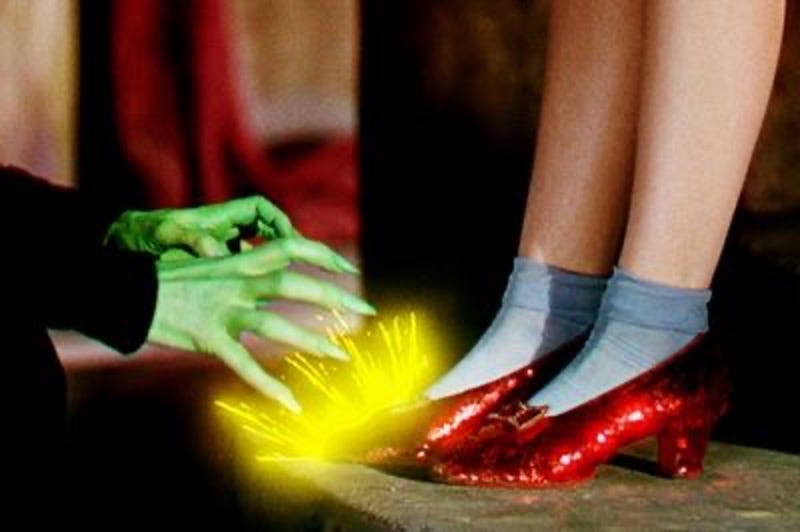
In these rapidly changing times, when the future often feels less like an open horizon and more like a shifting maze of uncertainty, one might ask where to find a pair of ruby slippers—the symbols of grounding and awakening that can carry us safely along the perilous road of life. In The Wizard of Oz, Dorothy receives her slippers after the sudden death of the Wicked Witch of the East, a moment of unexpected initiation. She does not ask for them, nor does she yet understand their power, but they become her protection, her anchor, her birthright. They remind us that the tools for survival and transformation are not granted from outside but are already ours to claim. And in a time when our culture seems stripped of guiding myths, Dorothy’s story offers more than nostalgia—it issues a clarion call to the young, urging them to step beyond the gray world of Kansas into the technicolor landscape of true adventure.
The tale is, on its surface, a children’s fantasy, but like all enduring myths it carries deeper truths. Dorothy begins in Kansas, a place rendered in black and white, stripped of vitality, dull as dust. It is the place of stasis, of quiet desperation, the place Thoreau warned against when he observed that most men lead lives devoid of purpose, trading wonder for survival. Then the tornado comes, and in its violent upheaval she is flung into another world. Mythologists have long recognized this pattern: the ordinary world broken open by crisis, the hero thrust into realms of trial and transformation. Joseph Campbell called it the hero’s journey. Gurdjieff called it the necessity of awakening. In either language, Dorothy’s voyage through Oz is the story of us all—the movement from passivity to participation, from sleep to awareness.
What makes Dorothy’s journey so compelling is not simply her courage but her companions. Along the yellow brick road, she meets the Scarecrow, the Tin Man, and the Lion. Each is incomplete, each believes himself deficient, and yet each is precisely what Dorothy needs. The Scarecrow seeks a brain, the Tin Man a heart, the Lion courage. Together, they embody the trinity of human faculties. Modern neuroscience has described them as layers of the “triune brain”: the neocortex of reason, the limbic system of emotion, the reptilian core of instinct. Long before, following the turn of the last century, G.I. Gurdjieff taught that human beings are “three-brained creatures,” with an intellectual, an emotional, and a physical-instinctual center. The tragedy, he warned, is that these centers rarely act in harmony; we live fragmented, mechanical lives, letting one center dominate while the others wither. Dorothy’s companions are not whimsical inventions but allegories of these centers, and the lesson is clear: without them, we are incomplete; with them, we may find wholeness.
The Scarecrow, though he believes himself foolish, is in fact resourceful and quick-thinking, embodying the intellect that too often underestimates itself. The Tin Man, rusted and stiff, fears he has no heart, yet he weeps at the slightest sorrow, revealing the depth of his compassion. The Lion, quaking in fear, imagines himself a coward, but when danger comes, he roars. These companions illustrate that what we think we lack may already be within us, dormant but waiting to be recognized. Gurdjieff would have said that each center must be remembered, that the work of life is to awaken them into balance. Dorothy cannot complete her journey without all three, nor can we.
Yet in our own time, the imbalance is stark. Education overdevelops the intellectual center, stuffing students with facts and abstractions while leaving their hearts and instincts unnourished. Emotions are often relegated to private life, dismissed as distractions from rational success. Instinct, our grounding in the body, is dulled by sedentary routines, digital mediation, and the comforts of convenience. The result is what MacLean’s model predicts and what Gurdjieff lamented: a humanity split against itself, clever but unwise, entertained but empty, capable of extraordinary technological feats yet unable to live with depth or harmony. The companions we need are still here, but they are banished to the margins of our awareness.
The slippers themselves are the symbol of integration. Unlike Achilles’ vulnerable heel, Dorothy’s shoes protect her feet, grounding her with every step she takes. They are the power that keeps her steady through the trials of Oz, and ultimately they carry her home. In the language of myth, they represent that unteachable inner resource, that capacity to remain awake and whole even amidst confusion. In Gurdjieff’s terms, they are the possibility of self-remembering: the moment when thought, feeling, and instinct align in awareness, and the human being becomes more than a machine. Without the slippers, Dorothy would be lost to the enchantments of Oz or enslaved by the Witch. Without our own version of them, we too are vulnerable to the endless distractions of modernity.
For the dangers of our time are not winged monkeys or melting witches but subtler enemies: the erosion of imagination, the trivialization of culture, the hypnotic lure of screens. Bread and circuses, the ancients said, are enough to pacify the masses, and today our circuses come in high definition, available on demand, promising entertainment without end. Tyrants and technocrats alike understand that to keep people amused is to keep them docile. We scroll, we click, we binge, and all the while the ruby slippers sit unworn at our feet. Youth, in particular, are captured by these forces. Deprived of rites of passage, of mythic adventure, they seek initiation in online subcultures, games, or risk-taking behaviors, substitutes that mimic the structure of myth but lack its transformative heart. The companions they long for are avatars, their yellow brick roads digital landscapes. Yet none of these can deliver the wholeness that only real journeying provides.
To step outside, to walk the world with awareness, remains as radical as ever. Walking—the simplest of acts—is a way of grounding intellect, heart, and instinct, bringing them into alignment. Thoreau knew this when he said he could not preserve his health and spirit unless he spent at least four hours a day sauntering through the woods. Gurdjieff required his students to practice movements and dances, embodied disciplines that integrated the centers. Dorothy’s journey is not abstract—it is walked, step by step, down a road that tests her companions, teaches her resilience, and leads her toward awakening. We too must walk, literally and metaphorically, to recover balance.
The myth of Oz also warns us of false guides. The Wizard, hidden behind his curtain, is the archetype of illusion: the external authority who promises solutions but has none. How easily we still fall for such figures—politicians, celebrities, or even algorithms that promise wisdom but deliver smoke and mirrors. The lesson is ancient: do not surrender your slippers. The witch may seize them only if Dorothy relinquishes them willingly. Likewise, our grounding awareness cannot be stolen outright; it can only be surrendered, usually by distraction, by neglect, by the slow erosion of attention. To keep our slippers is to keep our birthright, the connection to the earth beneath us and the powers within us.
The companions teach us not only balance but interdependence. Dorothy does not walk alone; she needs their intellect, compassion, and courage, just as they need her leadership. This, too, is a mythic truth. No one awakens in isolation. We require community, fellowship, shared struggle. The road is perilous, but it is walked together. In a culture that idolizes the individual and fragments the communal, this message is all the more urgent. We must re-learn that to be human is to be accompanied, that wholeness is found not in solitary success but in collective journeying.
If we read Oz with this mythic lens, its relevance to our own age becomes stark. We live in Kansas, monochrome and weary, longing for the rainbow but often too afraid to chase it. We face witches of envy and greed, wizards of illusion, roads that twist and threaten. And yet, like Dorothy, we already carry the means of return. The slippers are ours, the companions await, the journey calls. What remains is whether we will take that first step.
To youth today, the call is urgent. Do not wait for institutions to hand you meaning—they no longer know how. Do not accept a culture of trivial amusements as enough—they are shadows, not substance. Do not surrender your slippers for comfort, convenience, or fear. The world beyond the rainbow is real, and it is yours to explore. Like Dorothy, you will discover that the power you seek lies not at the end of the road but in the walking itself, in the companions you gather, in the balance you achieve among thought, feeling, and instinct. The myth of Oz is not escapism but initiation, not fantasy but a map of the soul.
We are living in times devoid of shared mythology, yet the myths still whisper if we know how to listen. They remind us that our task is not merely to survive but to awaken, to become whole, to harmonize the three centers of our being, and to walk with awareness. The ruby slippers gleam before us, the yellow brick road stretches on, the companions stand ready. The choice, as always, is ours: to remain in Kansas or to step into Oz. And if we step, as Dorothy did, we may find that even the most uncertain of times can be transformed into a journey of wonder, courage, and awakening.