
Stalking Attention
The Transformative Art of Dirt Time

“Think of our life in nature, – daily to be shown matter, to come into contact with it, – rocks, trees, wind on our cheeks! the solid earth! the actual world! the common sense! Contact! Contact! Who are we? where are we?” ~ H.D. Thoreau
For over thirty years, I’ve watched young people come alive in the woods much in the same way Thoreau came alive on Mt. Katahdin, as reported in his The Maine Woods. I’ve seen restless boys, numbed by hours of screen-time and digital noise, suddenly fall silent—not from boredom, but from awe. There is a moment when the chatter drops away, when they are crouched low in a patch of leaf litter, eyes tracking a squirrel or the flight of a crow, their bodies alert, senses open. That’s what we call “dirt time.” And in those moments, I’ve witnessed transformations that no standardized test or classroom rubric could ever measure.
Dirt time is not a program or a curriculum. It’s an initiation into real experience, a kind of sophisticated play where young people get “down and dirty”—literally. It’s about stalking—not the pixelated stealth of an Xbox fantasy, but the ancient art practiced by hunters who learned to move through the land without disturbing it, who cultivated awareness as a way of survival and reverence. The child learning to move quietly through the underbrush, feeling the rhythm of breath and heartbeat, is learning something about attention, about relationship, and ultimately about conscience.
In contrast, the “virtual stealth” of the gaming world is a distortion of this instinct. The screen promises engagement, but the body sits still. The nervous system fires as though in battle, but there is no real quarry, no real landscape, no real consequence. As I’ve told my students: that’s like staring into a light bulb and mistaking the glare for sunlight. You may feel alert—your heart racing, your reflexes sharp—but there’s no life beneath it. It’s a simulation of aliveness that drains vitality rather than deepens ~ a biological, emotional, and cognitive toxin.
The psychologist Leonard Sax spent years studying this phenomenon. In Boys Adrift, he identified video games as the number one contributor to what he calls a crisis of motivation among young men. Boys, he argues, are becoming less resilient, less ambitious, and less engaged than they were a mere generation ago. They are living in an environment “literally toxic to boys”—one that erodes purpose and undermines the natural drive toward mastery and independence. Add to this a school culture that rewards passive compliance and verbal abstraction over embodied learning, and the result is a generation of young people—especially boys—disconnected from both the natural world and their own inner compass.
As an educator who has spent a lifetime outside the classroom walls, I’ve seen the antidote firsthand. Dirt time rekindles a sense of purpose. It invites the whole being—body, mind, and spirit—back into participation with the world. It’s education in the most ancient sense: learning through direct engagement. The student who stalks through a field in silence, reading tracks, noting wind direction, and feeling the faint pulse of life beneath the soles of his feet, is not just learning ecology. He’s learning patience, humility, and self-control. He’s learning to care.
And that word—care—might be the most endangered species of all in today’s culture. The epidemic of youth violence in America, from school shootings to street fights recorded on phones for entertainment, doesn’t emerge from nowhere. It’s the shadow side of disconnection. When boys are severed from meaningful challenge, from physical adventure, from apprenticeship in courage and restraint, the energy of aggression has nowhere noble to go. What could have been disciplined into craftsmanship or shaped into guardianship turns inward, or lashes out in confusion.
I often told my students that what we’re really hunting out here isn’t deer or rabbits or even skill itself—we’re hunting attention. We’re stalking the capacity to see. The hunter’s silence, the tracker’s patience, the artist’s eye—these are kin to one another. Each requires that we become porous to the living world, that we feel our way into the pulse of things. It’s a form of meditation, but one that involves the whole body. And that’s precisely what our culture of abstracted virtuality has forgotten: the unity of body, mind, and moral sense.
The neuroscientist Paul MacLean offered one of the most illuminating metaphors for this in his model of the “triune brain.” He described the human brain as an evolutionary layering of three systems: the reptilian complex (governing instinct and survival), the limbic system (the seat of emotion and relationship), and the neocortex (the center of abstract thought and reasoning). Modern schooling, for the most part, tries to educate only the third—feeding language and logic while neglecting the deeper, older layers that connect us to our senses and our feelings. The result is imbalance: a mind clever enough to build algorithms that can manipulate billions of people, yet unable to feel the moral weight of that power.
When I watch boys building shelters from branches or crawling through tall grass in mock pursuit of one another, I see all three brains engaged. Instinct sharpens the body; emotion fuels camaraderie and empathy; intellect orchestrates planning and reflection. This is whole-brain education, and it’s not a theory—it’s a lived reality. The natural world demands integration. You can’t fake focus in the woods. If your awareness drifts, you trip over a root, startle the birds, or lose track of your quarry. Every movement carries feedback, every sound and scent and texture is a teacher.
In contrast, the classroom has become an environment of sensory deprivation. Fluorescent lights hum overhead, windows are sealed, and students are told to sit still while their brains are force-fed abstractions detached from any visceral meaning. Even so-called “environmental education” programs are often sanitized simulations—virtual field trips and smartboard lessons about “ecosystems” taught indoors. We’ve mistaken information for understanding, when what children truly need is what Thoreau became steeped in on Mt. Katahdin in Maine ~ contact.
Contact—with soil, with wind, with living things—is what grounds the psyche. It cultivates humility and gratitude. When a child kneels in the mud, tracking the faint print of a fox, they are not just learning biology. They are being drawn into moral relationship. They begin to feel that the earth is not scenery or resource but kin. This is what I mean when I say that “dirt time” is not just about attention, but conscience. It teaches, through the body, that our actions ripple through a web of life much larger than ourselves.
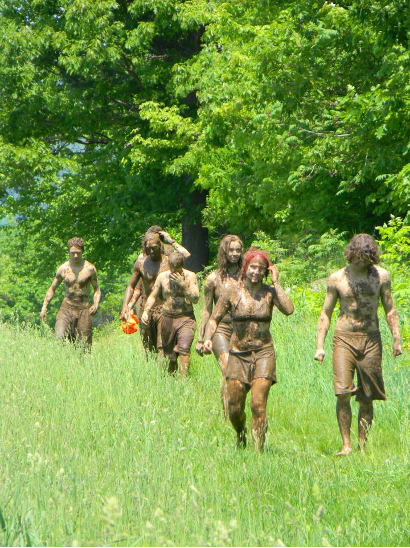
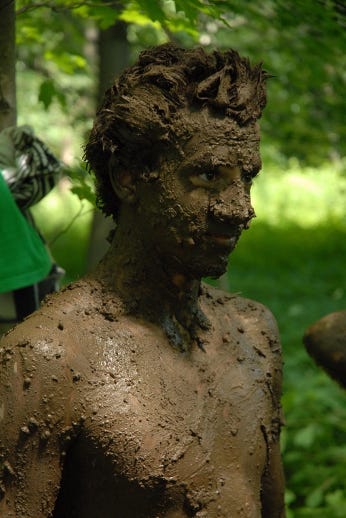
I’ve had parents approach me, worried about the mess, the scratches, the scraped knees. They wonder why their child returns home covered in mud, exhausted, grinning from ear to ear. I tell them: what you’re seeing is learning in its purest form. You’re seeing energy redirected—from virtual aggression into creative, cooperative, embodied play. You’re seeing the return of wonder. You’re seeing your child become human again.
It’s worth noting that the most enduring educational models—whether in indigenous traditions, in crafts apprenticeship, or even in the monastic schools of old—have always emphasized rhythm, ritual, and relationship to place. There was time to wander and time to work, time to listen and time to act. Knowledge was not just transmitted; it was embodied. The old hunters and gatherers who taught their young to stalk and to move unseen were not merely training them to survive; they were cultivating perception, reverence, and moral imagination. To walk softly through the world was to honor the life within it.
Today, “stealth” has been repackaged as a gaming feature—an adrenaline rush divorced from consequence. But real stealth, the kind you learn in the woods, is sacred. It teaches empathy. To move silently through a landscape, you must attune to it, merge with it. The wind becomes your ally; the ground, your teacher. You begin to notice patterns you’d missed before—the subtle shift in bird song, the scent of rain, the tremor of a branch. The modern mind, trained to react to images, begins to remember how to listen.
As an educator, I’ve seen dirt time heal what screens divide. I’ve seen boys who could barely hold focus for five minutes in a classroom spend hours constructing a blind or tracking a trail. I’ve seen the joy of discovery return to faces dulled by overstimulation. And perhaps most importantly, I’ve seen conscience awaken—quietly, almost imperceptibly—in the way a child learns to handle a frog gently, or replaces a stone where they found it. These are small gestures, but they are the foundation of civilization. Without them, all the data and diplomas in the world amount to nothing.
The author, Doctor of Osteopathic Medicine (DO), and teacher Keith Buzzell, building upon MacLean’s insights, described true human development as the integration of multiple centers of knowing—instinctive, emotional, and intellectual (with awareness simultaneously in all three constituting the spiritual development of Conscience). Modern culture isolates and inflates the last one, intellect, as if the others were primitive relics. But Buzzell reminds us that the health of the whole depends upon balance. Without grounding in the sensory and emotional intelligence of the body, thought becomes sterile. Without a conscience rooted in awake and aware lived experience, morality becomes ideology. It’s no wonder, then, that we see such alienation and rage among youth who have been cut off from the rhythms of the natural world. Their moral compass spins wildly, seeking true north.
Dirt time, humble as it sounds, is a form of recalibration. It reawakens the integrated self—hunter, artist, philosopher, caretaker—all at once. It is education as ecology: every sense alive, every layer of the brain engaged, every gesture interwoven with the larger web of life. In an age where children know more about digital avatars than actual animals, where violence is consumed as spectacle rather than felt as sorrow, this kind of education is not nostalgic. It is revolutionary.
We are, after all, creatures of earth. To be human is to be made of soil and starlight, instinct and imagination. When we forget this, we lose the ground of our being—literally and figuratively. The cure is not to double down on technology, nor to moralize about masculinity, but to bring the body back into learning, to bring conscience back into play. It begins, simply, by stepping outside, by getting our hands dirty, by learning once again to stalk the living world not as conquerors, but as participants.
So yes—let’s roll in the mud, build shelters from fallen limbs, move silently through the trees. Let’s remember what it means to be fully alive, to feel the pulse of attention and the quiet joy of belonging. Dirt time is not a retreat from civilization. It’s its renewal.
I am happy to jawbone at any time with anybody if the wish to explore is there.
The Badger