
Waking from the Doldrums

Norton Juster’s The Phantom Tollbooth has long stood as a whimsical parable of awakening—an ode to curiosity, play, and intellectual adventure. Its hero, Milo, embarks on a journey that echoes through the corridors of childhood memories and deep into the human soul. Milo begins the story encased in a fog of boredom, a state of mind that feels all too familiar in our own time. But let us not dismiss this book as mere childhood fancy. It is a tale that speaks not only to young readers, but to the child within us all—the curious, wondering self too often buried beneath the rubble of adult obligations, busyness, and distraction. To walk with Milo through the lands of Dictionopolis and Digitopolis is to take a journey into the imagination, where learning springs not from compulsion but from delight. And in that spirit, the book invites us to look more closely at what deadens our sense of wonder today, and how we might recover it.
At first glance, Milo seems an unlikely hero. “There was once a boy named Milo who didn’t know what to do with himself—not just sometimes, but always,” Juster writes. Milo is not unhappy, exactly. He is dulled—apathetic, unmotivated, lost in a kind of ambient mindset that wraps around him like fog. It is this state—what Juster names “the Doldrums”—that he must escape before his real adventure begins. But Milo’s boredom, while fictional, rings with unsettling truth. It is not simply the boredom of children who long for play, but the more dangerous boredom of minds disengaged from meaning. And if we are honest, it is not only children who drift in this way, but we adults, too—lulled by the endless noise of modern life, dulled by routine, seduced by glowing screens that promise novelty but rarely offer depth.
Today, the “Doldrums” have taken on new forms. We carry them in our pockets. They follow us to work, home, school, and even to bed. The average person now spends more than nine hours a day in front of a screen—phone, computer, television—consuming content, scanning headlines, swiping and scrolling in an endless loop of simulated engagement. Unfortunately, the new “form” today is peddled as entertainment, or more specifically, a wonderland rabbit hole called entrainment.
In the award-winning documentary Screenagers, filmmaker Delaney Ruston explores the startling effects of this shift, particularly on young people. The film’s statistics are sobering: teens average more than six and a half hours per day of screen time outside of school. And that’s not counting the multitasking that splits their attention even further. What was once downtime—the space to be bored, to wonder, to reflect—has been filled to the brim with flickering images and digital chatter.
In many ways, we have traded the old, fertile kind of boredom—the kind that leads to imaginative play, long walks, daydreaming, and unexpected insights—for a new type of passive stimulation that mimics activity but deadens the spirit. This new boredom is easy to name but harder to identify. Splashed every morning across the front page (headlines) of the NY Times, it hides beneath bright lights and busy thumbs. It looks like productivity, entertainment, and even social connection. But beneath the surface, it breeds the same fog Milo finds himself in at the beginning of his story: a listless disengagement from the real world, a disconnection from the self.
In The Phantom Tollbooth, Milo’s escape from this haze begins not with a screen or an app, but with a strange, magical tollbooth that appears in his room. When he drives through it—yes, drives, in his toy car—he crosses the threshold from tedium to wonder. Perhaps it was the car culture of the 1950s, coupled with Juster’s connection to the Ford Foundation, that influenced the choice of automobile as Milo’s vehicle of adventure. Tossing a coin into the tollbooth would have symbolized freedom and discovery during an era when cars represented newfound mobility. Yet, the essence of true adventure lies beyond mere physical transport. We forgive the automotive imagery as a reflection of its time, for genuine adventure transcends the vehicle that carries us.
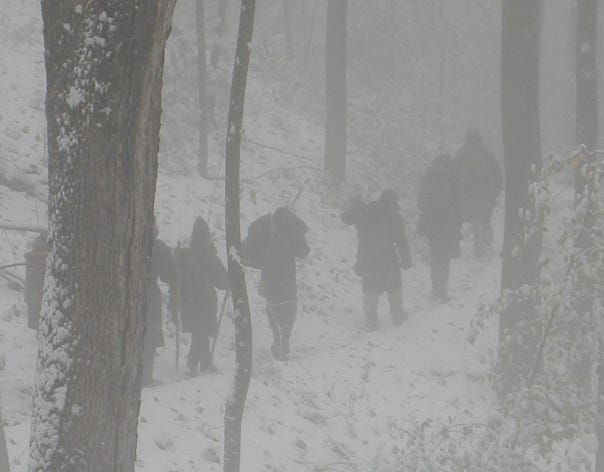
One might imagine a different version of the story, more attuned to our own time, where Milo sets off not in a car but on foot, walking through the lands he is about to explore. The physical act of walking, of slowing down, of moving deliberately through space, would mirror the inner journey he takes—a journey from indifference to awareness, from ignorance to wisdom.
Walking, as many great thinkers have shown, is itself a kind of thinking. Thoreau wandered the woods of Concord not only to commune with Nature but to stir the depths of thought. Kierkegaard claimed that he knew no thought so burdensome it could not be walked off. And more recently, neuroscientists have shown that walking activates parts of the brain associated with creativity and memory. It is no coincidence that some of the most luminous characters in literature—Frodo, Dante, the Little Prince—travel not in cars but on foot, journeying through worlds that transform them from within. It’s tough for me not to see an opening to highlight the value of walking, for intentional self-directed movement holds a key to these troubling, disconnected times!
Central to Milo’s odyssey, though, is his arrival in the Kingdom of Wisdom, ruled by King Azaz and his brother, the Mathemagician. Their realm is divided over the power of words and numbers, foundational elements shaping understanding and experience. Milo’s quest becomes a mission to restore order and reconcile these forces, navigating treacherous terrain like the Mountains of Ignorance and the Sea of Knowledge. His journey mirrors our own struggles with imbalance and the quest for meaning in today’s complex world.
Milo’s journey, too, is transformative. As he wanders through Dictionopolis and Digitopolis, meets the Whether Man and the Spelling Bee, and sets out to rescue the banished princesses Rhyme and Reason, he comes alive. What he learns is not found in a textbook, but in the world itself—in puzzles, riddles, mistakes, and conversations. This is no ordinary education. It is what poet David Whyte calls “the conversational nature of reality,” where learning is born from encounter, not dictation.
Juster, along with illustrator Jules Feiffer, was acutely aware of the limitations of traditional education. In their interviews, they reflected on how formal schooling often stifles curiosity in favor of control, measuring learning in units and outcomes, rather than wonder and delight. In contrast, Milo’s education is self-propelled, sparked by questions and carried forward by experience. He learns because he wants to. Because the world itself has become intriguing, alive, beckoning.
Consider tales like The Sword in the Stone, Alice in Wonderland, The Wind in the Willows, and Mary Poppins. Each protagonist undergoes profound change not through rote learning but through direct engagement with life. Arthur learns self-reliance and questions authority, Alice challenges absurdity, Mole discovers the power of community, and the Banks children expand their horizons beyond familiar limits. Education in these stories transcends mere acquisition of facts—it embodies a holistic journey of self-discovery that nurtures mind, body, and spirit.
Tolstoy once remarked that boredom arises from “the desire for desires”—a yearning unmet, leaving us feeling unfulfilled. In The Phantom Tollbooth, the Doldrums symbolize this malaise, reflecting a modern ennui where distractions abound, pulling attention in countless directions. Yet, the antidote lies in the act of thought—stepping away from noise to allow the mind to wander, reflect, and wonder. Attention.
This stands in stark contrast to the hyper-mediated learning environments many children now inhabit. In Screenagers, we see how digital technology has entered even the classroom—how lectures are accompanied by multimedia, and homework often completed on laptops awash in competing tabs. The film does not demonize technology; it acknowledges its value. But it also raises a crucial concern: when children are constantly stimulated, they lose the ability to be bored in a way that fosters growth and development. And without boredom, there can be no genuine curiosity. For it is only in the silence, in the pause between inputs, that the question arises: what now?
Milo’s story, then, is not just a fantasy. It is a prescription. A call to rekindle the lost arts of attention, imagination, and reflection. The book reminds us that meaning is not something handed to us by an algorithm—it must be discovered, and often rediscovered, through engagement with the real. And here, again, walking becomes a metaphor of profound importance. To walk is to resist the tyranny of the screen. It is to enter into conversation with the land, the self, and the invisible threads that connect all things.
Consider how the Princesses Rhyme and Reason are portrayed—banished from the Kingdom of Wisdom by a foolish quarrel between the lovers of words and numbers. It is a brilliant allegory for our divided age, where polarized thinking has exiled wisdom. In rescuing them, Milo must learn to reconcile opposites, to value both logic and imagination, and to see through the false dichotomies that govern so much of modern discourse. This, too, is part of his education (and ours)—a healing of the fragmented self.
But perhaps the most potent lesson of The Phantom Tollbooth is its insistence that learning is not a chore, but a joy. That play is not the opposite of seriousness, but its companion. And that the world, far from being dull and predictable, is laced with mystery—if only we have the eyes to see it.
In this spirit, I return to the walk. When I think of Milo, I do not see him trapped in his little car, but wandering through fields of wordplay, forests of metaphor, and mountains of meaning—feet on the ground, mind aloft. The antidote to the Doldrums is not more distraction, but more attention. Not more screens, but more steps. Not more information, but more wisdom.
So if you find yourself dulled by routine, weary from newsfeeds, or lost in the maze of digital detritus, take a walk. A real one. Without earbuds or apps. Let your mind stretch beyond the confines of curated feeds. Let your imagination, like Milo’s, take the reins. We need not wait for a tollbooth to appear. The journey begins with a step into the world, into thought, into wonder.
As Juster so beautifully reminds us, “It’s not just learning that’s important. It’s learning what to do with what you learn and learning why you learn things at all.” That kind of learning can’t be downloaded. It must be lived.